



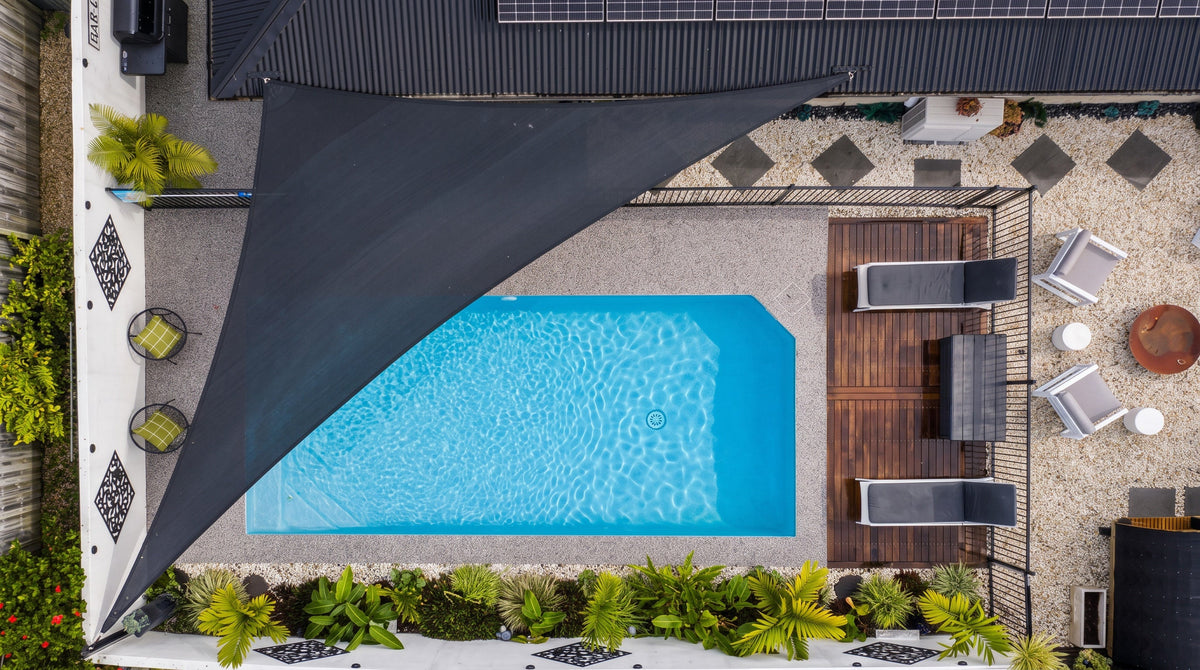
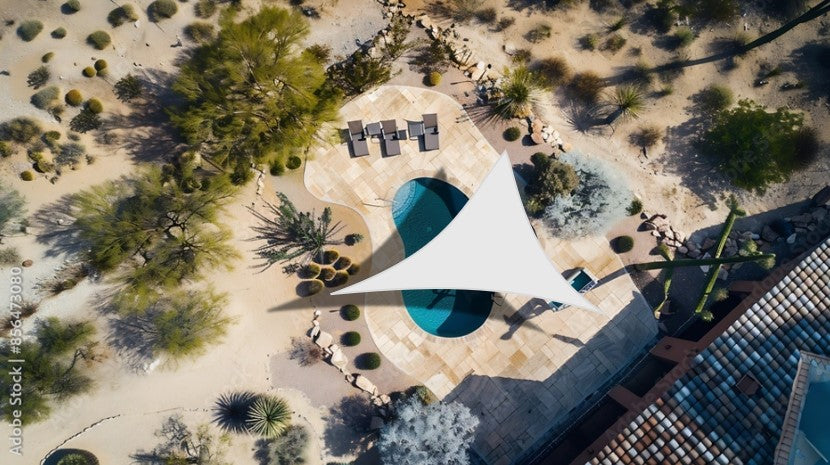
If you want to install a Shade Sail over your pool, there are three main ways to support it: conventional poles with concrete footings, weighted or freestanding poles, or a freestanding frame.
Which option makes sense largely depends on one thing: what stage is your pool area at?
If you're planning a new pool, installing conventional footings is generally much easier and the preferred option. If your pool is already surrounded by finished paving and landscaping, we understand that digging large footings may be exactly what you're trying to avoid.
That's why it's worth considering your installation options before getting too far into the Shade Sail itself.
The Shade Space flowchart below walks through three options and helps identify which one is worth investigating for your pool area.

The 3 Ways to Install a Shade Sail Over a Pool
The three installation methods shown in the flowchart are:
Option A – Conventional poles and concrete footings
Option B – Weighted or freestanding poles
Option C – Freestanding frame or pergola-style structure
All three can provide the support needed for a pool Shade Sail, but they suit quite different situations.
Let's look at each one.
Option A: Conventional Shade Sail Poles and Concrete Footings
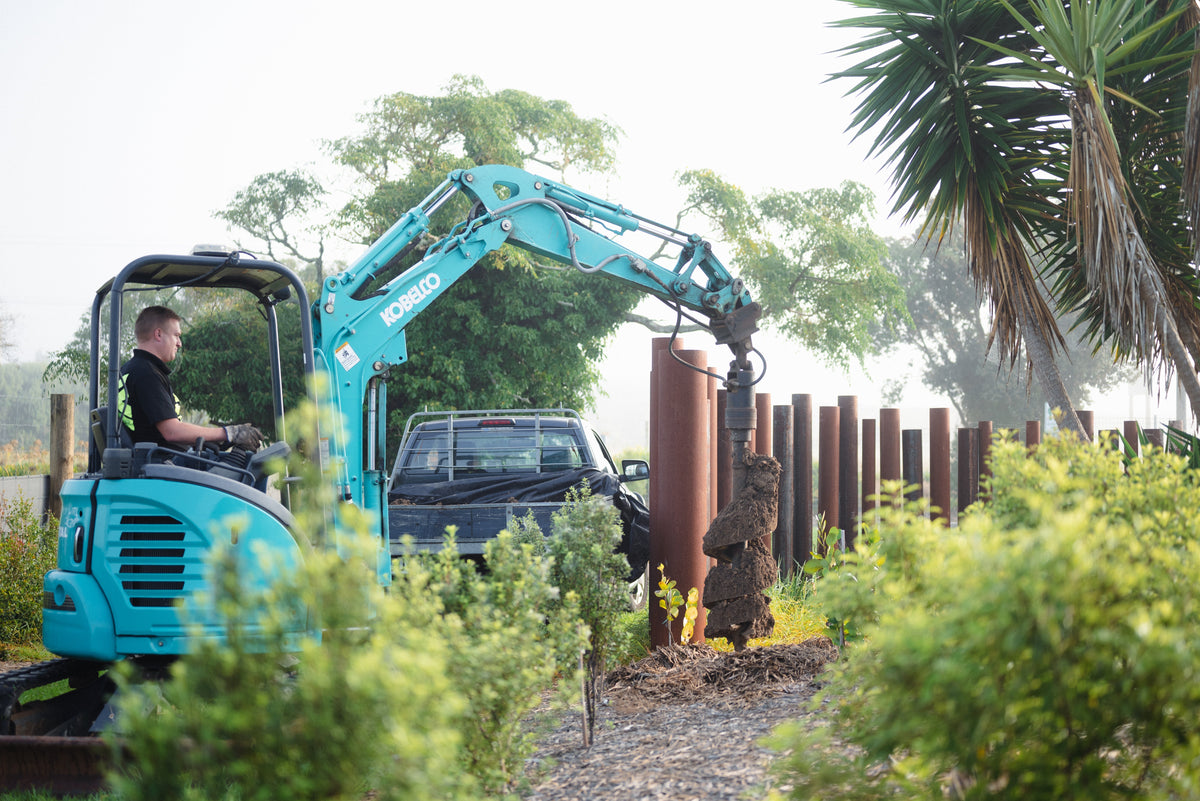
Where practical, conventional Shade Sail poles installed with suitable concrete footings are the preferred permanent solution.
This option is particularly straightforward when you're still planning the pool or developing the surrounding area.
At that stage, pole positions and footings can be incorporated into the project before the final paving and landscaping are completed.
It can also be used around an existing pool if there is suitable access and you're prepared to disturb the area required for the footings.

When does Option A make sense?
The flowchart points toward conventional poles and footings in three situations:
If you're planning or about to start the pool project, Option A should be considered from the beginning.
If the pool area is under construction, ask whether there is still practical access for digging the required footings, removing soil and pouring concrete. If there is, Option A remains practical.
If the pool area is completely finished and landscaped, Option A can still be used if you're prepared to disturb the finished area to install the footings.
There is also the possibility of combining conventional poles with a suitable structural building or wall mounting points where the site allows it.
What information do you need for Option A?
Once you've decided conventional poles are practical, start by putting together:
- photos of the pool area;
- a simple plan or sketch showing the pool, paving, buildings and proposed shade area;
- the important dimensions; and
- approximate proposed pole positions.
If there is a potential structural building or wall mounting point, include that on the sketch and in your photos as well.
From there, the Shade Sail layout, pole positions, pole requirements, footing requirements and suitable hardware can be worked through in more detail.
Option B: Weighted or Freestanding Shade Sail Poles
Option B is particularly useful when the pool area is already finished and you don't want to dig conventional concrete footings.
This is a common situation.
The pool might already be surrounded by paving, gardens or other finished landscaping. Digging conventional footings could mean cutting or lifting finished surfaces, excavating holes, removing spoil and then repairing the area afterward.
A weighted or freestanding pole arrangement gives you another route to investigate.

When does Option B make sense?
The flowchart directs you toward Option B when conventional footings have become difficult or undesirable.
For example, your pool area might still be under construction, but access for excavation and concrete work is no longer practical.
Or the pool and landscaping may be completely finished and you're simply not prepared to disturb it to install conventional footings.
In either situation, a weighted or freestanding pole solution is worth considering before moving to a complete freestanding frame.
Suitable structural building or wall mounting points can also potentially be combined with this type of installation.
A freestanding pole still needs substantial support
It's important not to interpret "freestanding" as meaning a lightweight or easily movable Shade Sail pole.
The Shade Sail still transfers loads into the pole and its supporting base, particularly in windy conditions.
The weighted support therefore needs to be properly designed for the Shade Sail and site. The available space for the base also becomes an important part of deciding whether this option is practical.
What information do you need for Option B?
Start by taking photos that clearly show the finished pool area and the access limitations.
Then identify:
- the area you want to shade;
- the space available for bases, planters or other weighted supports;
- the main dimensions; and
- paving, decking, services or landscaping you don't want disturbed.
This information helps establish whether a weighted or freestanding pole arrangement is practical for the available space.
Option C: Freestanding Frame or Pergola-Style Structure
If conventional footings don't suit the site and a weighted pole arrangement isn't practical, the third option is a freestanding frame.
With this method, the Shade Sail is supported within its own frame.
The important difference is that you're no longer relying on separate external mounting points in the same way as a conventional Shade Sail installation. Instead, the frame and Shade Sail are considered together as one complete shade system.

When does Option C make sense?
Option C becomes relevant when you've worked through Options A and B and neither provides a practical solution for the pool area.
For example, you may not want to excavate conventional footings, but there may also be insufficient room for the bases required by individual weighted poles.
If there is enough clear space for a complete freestanding structure, a frame or pergola-style solution may be worth considering instead.
What information do you need for Option C?
The important measurement here isn't just the area you want shaded.
You also need to establish the clear space available for the complete frame footprint.
Start with photos and dimensions of the pool area, then note any restrictions created by:
- the pool edge;
- paving;
- fences;
- access; and
- existing landscaping.
Because the Shade Sail is supported within the frame, the frame and sail need to be considered as a complete system rather than two separate components.
Which of the 3 Shade Sail Installation Options Should You Start With?
The easiest way to decide is to work through the pool area in the same order as the flowchart.
If you're planning the pool or outdoor area: start with Option A – conventional poles and footings.
If construction is underway: decide whether conventional footing installation is still practical. If it is, look at Option A. If it isn't, investigate Option B – weighted or freestanding poles.
If the pool and landscaping are completely finished: decide whether you're prepared to disturb the finished area for conventional footings. If you are, consider Option A. If you're not, investigate Option B.
If a weighted or freestanding pole arrangement isn't practical, move on to Option C – a freestanding frame.
That is really the purpose of the flowchart. You don't need to solve every detail of the installation immediately. You just need to identify the most practical route before progressing further.

Start With the Installation Method, Then Plan the Shade Sail
When working out how to install a Shade Sail over your pool, choosing between these three installation methods is a good first step.
For a new pool, conventional poles and concrete footings will often be the first option to investigate.
For an established pool where you don't want to disturb finished paving or landscaping, weighted or freestanding poles provide another possibility.
And where neither of those approaches works, a freestanding frame may provide a third route.
Whichever method you choose, the supporting structure still needs to account for the Shade Sail size, shape, fixing-point heights, tension and wind loads. Final structural specifications should be confirmed by an engineer or appropriately qualified professional where required.
Once you've identified Option A, B or C, use page two of the flowchart to collect the photos, dimensions and site information relevant to that installation method. From there, you can work through the appropriate Shade Space pole, footing, hardware and measuring information before ordering your custom-made Shade Sail.





Share:
How to Clean a Shade Sail: The Best Way to Clean Your Shade Fabric